 selectvenue
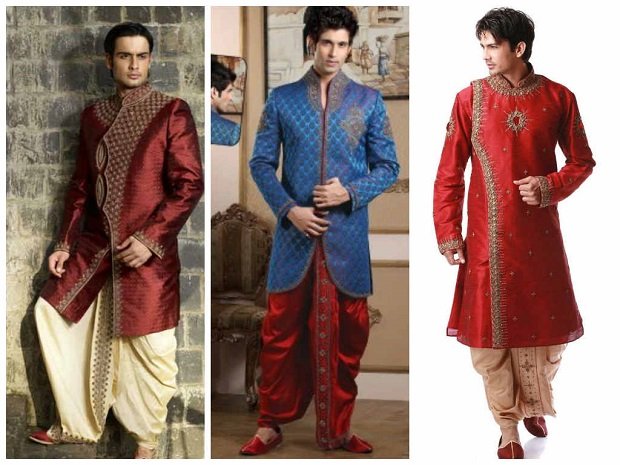
The term “dhoti” refers to a style of sarong that externally resembles a pair of pants. Additionally, it goes by the names vesti, chaadra, panche, dhotar, mardani, panchey, and dhuti. It is typically worn during celebrations, religious services, or weddings. Indian subcontinental males typically wear the dhoti, a garment that encircles the lower portion of the body. It is fashioned from a rectangular piece of cloth that is typically left unstitched. Typically, the cloth is around 15 feet long. The entire length is tied in either a front or rear knot after being wrapped around the men’s legs and waist. They often come in a variety of textures and basic or vivid colours. Wearing silk dhotis, which have embroidered trim around the edges, is reserved for ceremonial settings.
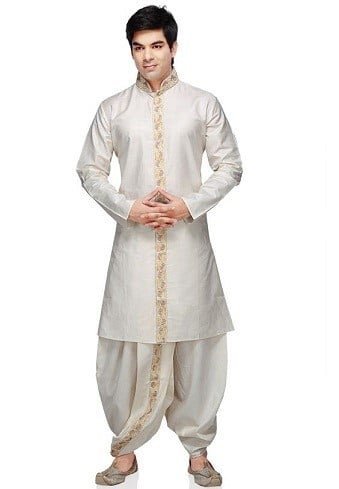

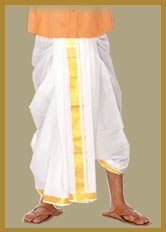
Depending on the situation, men can casually or formally dress the dhoti, and both styles are wrapped differently. As a more relaxed daily outfit, the dhoti is wrapped securely around the legs. The two loose ends of the dhoti are then tucked at the back to give the illusion of tight-fitting pants after the rear is dragged to the front and firmly tucked at the waist. A formal dhoti style involves passing it between the legs, tucking it in in the rear to cover the legs loosely, and flowing it into long pleats in the front.
History Of Dhoti


The Sanskrit word “dhauti,” which is the root of the English “dhoti,” literally translates to “to clean or wash.” It was seen as a tidy item of clothing that was worn frequently. Dhoti fashion originated with the prehistoric Antriya. Although the precise beginnings of this ancient traditional attire are unknown, they have been traced back to the fifth century BC. Men of the Indus Valley Culture (IVC), a Bronze Age civilization, were discovered to wear the dhoti most of the time, according to evidence. The northern and southern regions of the Harappan civilization were where this garment was most prevalent.
Since the cotton industry grew strongly in ancient India, the dhoti is made of the finest cotton. These fabrics were often coloured after they were spun and woven to enhance colour and vitality. Cotton was chosen since it was the easiest material to work with. Herodotus, an ancient historian, called it “very beautiful”. The comfort it offers and ease of wearing for daily tasks helped the dhoti later spread to all of India. The hot and dry climate of the Indian subcontinent was another, more sensible explanation for this type of apparel. This piece of clothing is ideal for wearing in the blazing heat since it allows for airflow.
Significance Of Dhoti

The utterly magnificent character of this clothing is deeply ingrained in the culture, having been a component of the regalia worn by India’s ancient emperors and monarchs. The attire, which is wrapped around the building depicting Ashoka, the Chakravartin King, in Amravati, is based on old architectural styles. For monarchs, poets, and other opulent people, beautiful colours and tints were combined with ostentatious gold-threaded embroidery.

The dhoti has long been associated with class among the powerful in ancient India, and a more ornate design was used to denote social standing. The dhoti is known by a variety of names depending on where one is in India.

The conventional dhoti is subtle but nonetheless appealing and current. It is regarded as the representation of the esteemed Indian culture. When worn, it gives the appearance a traditional undertone while providing a sense of majesty. For social occasions, religious ceremonies, and festivities, Indian men still favour wearing this article of clothing, particularly in the southern part of the country. It looks fantastic with a kurta, a straightforward achkan, or a galabandh suit.

The importance of the dhoti may be shown in the fact that males, especially the groom, wear it as their first choice of apparel for wedding festivities. When visiting India, visitors are encouraged to purchase these exquisite garments from local stores or online. It is simple to get carried away by the fascinating history of what was and is current India; there is so much to be learned about Indian culture just through their apparel. It is a lovely voyage to see their culture through the prism of time, attire, and fashion.